
Traditional Dictionary Definitions
Intelligence is broadly defined as the ability to acquire, understand, and apply knowledge and skills. It involves reasoning, problem-solving, learning, adapting to new situations, and grasping abstract concepts.
Learning and Intelligence
The current education system focuses primarily on acquiring knowledge and practicing problem-solving. While students are encouraged to engage in higher-order thinking, educators do not always teach this skill and expect students to know how to learn. In addition, traditional educators pass onto their students what they learned themselves, i.e., that intelligence is inherited and fixed. The notion that intelligence can be enhanced with effort and work has not yet been fully adapted into the system.
Expanding Intelligence
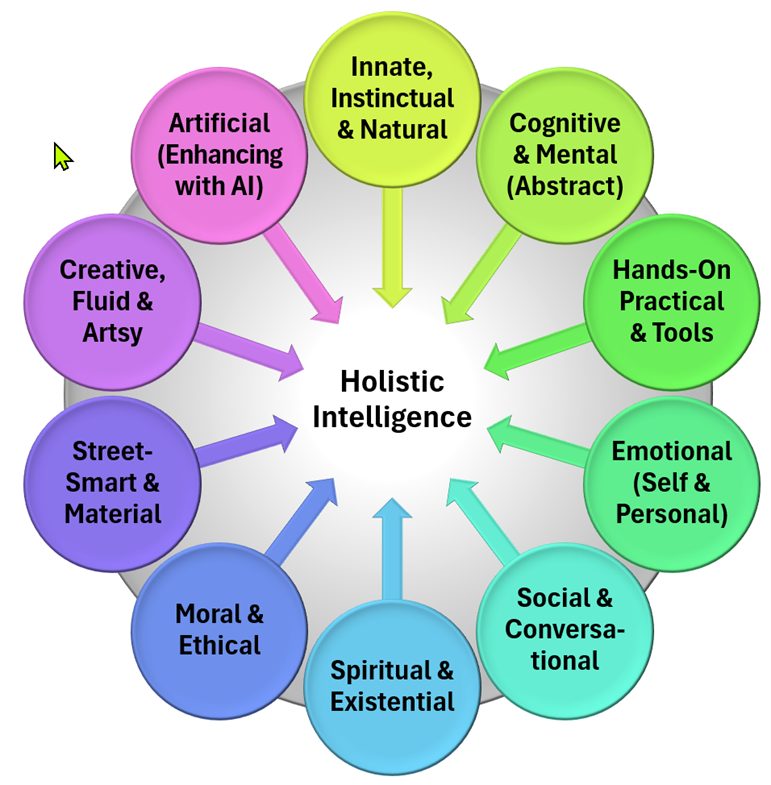
We find traditional intelligence definitions quite limiting and not representative of the spectrum of human intelligence. Our understanding of intelligence recognizes the diverse and interconnected nature of human abilities, highlighting the significance of integrating different forms of intelligence. We define Holistic Intelligence as a multifaceted and comprehensive amalgamation of various intelligence categories described below:
- Innate, Somatic, and Natural Intelligence: These are the inherent abilities, instincts, and somatic reactions individuals are born with, which allow them to navigate and adapt to their natural environment effectively.
- Cognitive Intelligence: Intellectual abilities related to reasoning, problem-solving, learning, memory, critical thinking, and higher-order thinking.
- Hands-on Intelligence: The capacity to apply knowledge and skills in real-world situations, being street-smart, and demonstrating practicality and efficiency.
- Emotional Self-Understanding: This is the ability to feel fully, understand, and manage one’s emotions. It includes self-care, compassion, and kindness towards oneself.
- Social and Conversational Intelligence: This involves navigating social interactions, understanding others’ emotions, and being empathetic. It is about active listening, skillfully expressing yourself, co-creating, and collaborating wholeheartedly.
- Spiritual and Existential Intelligence: This involves developing consciousness, asking profound questions about existence, discovering one’s purpose in life, and connecting with all living creatures in the larger cosmos.
- Moral and Ethical Intelligence: The capacity to discern right from wrong, address ethical dilemmas, make thoughtful decisions, and embrace diversity, equity, and inclusion. It also encompasses a deep concern for society and the world.
- Materialistic Intelligence: This is about using essential skills to navigate everyday life and career challenges, gain societal recognition, and achieve material wealth to contribute to the world.
- Creative, Artistic, and Fluid Intelligence: This combines aesthetics with creative problem-solving, emphasizes innovation and discovery, and adapts to new challenges.
- Artificial Intelligence: This is about enhancing human intelligence through hardware (tools, artificial organs, etc.) and software, bringing what humans can accomplish to a new level.
0 comments